

How Did We Get Here?
The Lie of the Debt Economy, or Exposing the False Origin Story of Money

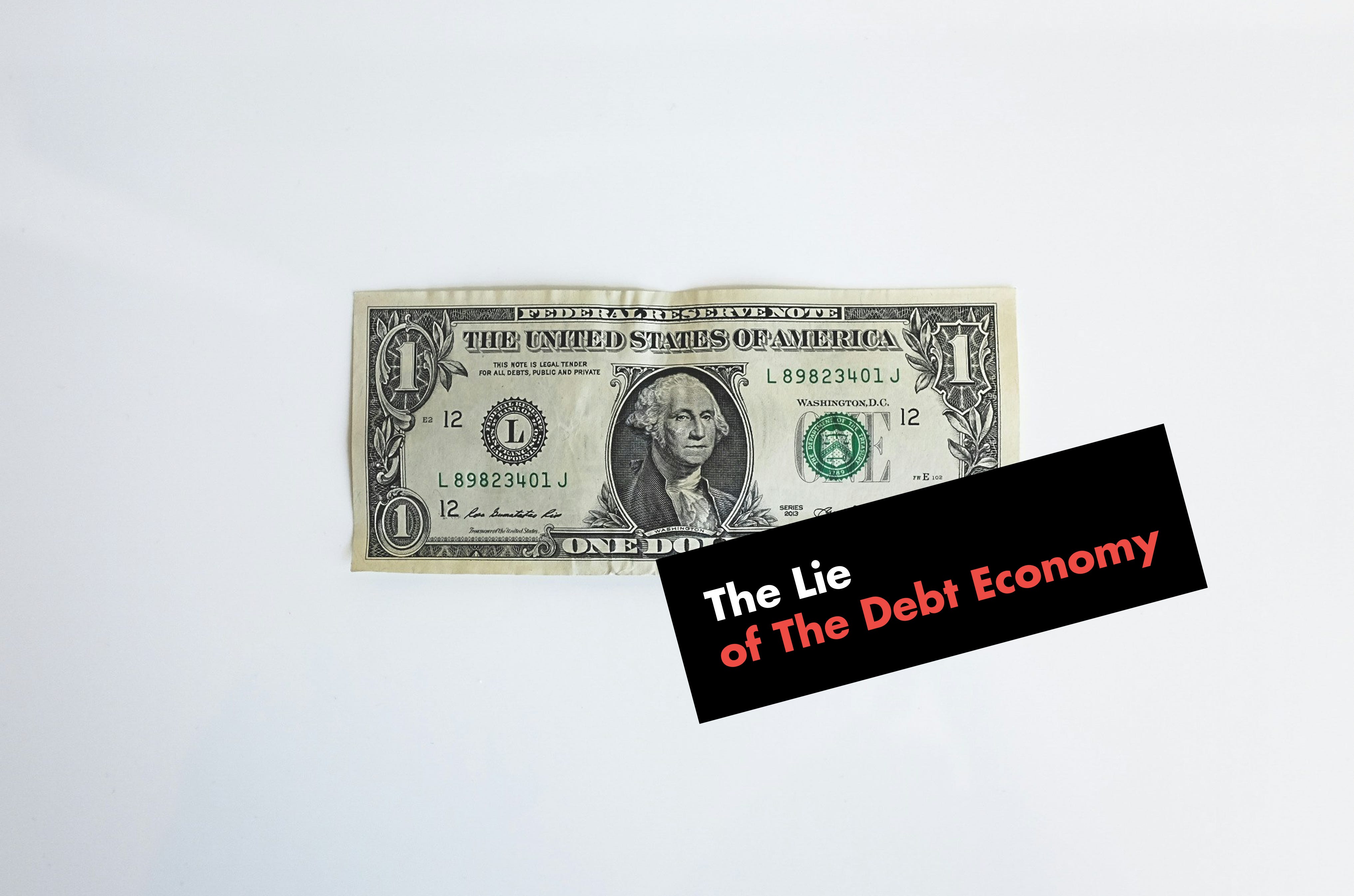
This is the second in a series of theological essays on what most people call “the marketplace” and “the economy.” If you haven’t read the first essay (A Scandalous Tale of Two Economies), please do so before reading this one.
Since I am not an economist, historian, archaeologist, or anthropologist, I needed to do some deep reading to prepare for a theology course I teach on marketplace leadership. There’s nothing worse than a theologian who makes claims outside their discipline without doing the research first.
That research led me to David Graeber’s Debt: The First 5,000 Years, an evidence-based history and analysis of money, debt, markets, and economies as we experience them today. The book is essential reading not only for its historical scope, but for Graeber’s penetrating and compassionate analysis of how things were, how things are, and how things could be for people who both benefit from and are crushed by the accumulation of wealth and power in a global economy that reaches deep into national and local life.
One of many things that melted my brain: the standard story people tell about the origins of money—barter, then coins, then credit—never actually happened, and the people who know this have largely chosen to ignore the real story. As Graeber demonstrates in far more detail than I have space for here, conventional economic histories have things “precisely backwards.”¹ Virtual money and credit came first, not barter. Here’s why.
The standard account goes like this: before money existed, if you needed a goat, you would find someone with a goat and offer to trade five chickens for it. The goat’s owner would then decide whether the trade was fair, and if not, you’d haggle until you reached an agreement. Eventually, people realized they could invent something to represent value—money— and trade that instead of chickens.
But, as Graeber points out, no archaeologist or historian has ever found evidence that this is how people actually operated before money. When you think about it, the reason becomes clear: a person with a goat is rarely looking for five chickens at the exact moment a person with five chickens is looking for a goat. So instead, people invented systems — tokens, ledgers, tallies — to represent value and track debts within localized networks of exchange that gradually grew into what we now call markets or economies. As Graeber writes:
The most shocking blow to the conventional version of economic history came with the translation, first of Egyptian hieroglyphics, and then of Mesopotamian cuneiform, which pushed back scholars’ knowledge of written history almost three millennia, from the time of Homer (circa 800 BC), where it had hovered in [Adam] Smith’s time, to roughly 3500 BC. What these texts revealed was that credit systems of exactly this sort actually preceded the invention of coinage by thousands of years. The Mesopotamian system is the best-documented, more so than that of Pharaonic Egypt (which appears similar), Shang China (about which we know little), or the Indus Valley civilization (about which we know nothing at all). As it happens, we know a great deal about Mesopotamia, since the vast majority of cuneiform documents were financial in nature.²
Beyond being fascinating dinner-party facts, why does correcting this inaccurate story matter for ordinary people today? Let me answer that with another question: who benefits most—and least— from this false account? Those who benefit most are the powerful and wealthy; those who benefit least, or not at all, are everyone else. Graeber uses the 2008 financial crisis as a case in point:
September 2008 saw the beginning of a financial crisis that almost brought the entire world economy screeching to a halt. In many ways the world economy did: ships stopped moving across the oceans, and thousands were placed in dry dock. Building cranes were dismantled, as no more buildings were being put up. Banks largely ceased making loans. In the wake of this, there was not only public rage and bewilderment, but the beginning of an actual public conversation about the nature of debt, of money, of the financial institutions that have come to hold the fate of nations in their grip.But that was just a moment. The conversation never ended up taking place. The reason that people were ready for such a conversation was that the story everyone had been told for the last decade or so had just been revealed to be a colossal lie. There’s really no nicer way to say it.³
To put it plainly: a lot of the so-called experts who manage “the markets” and “the economy” have little interest in acknowledging—to themselves or anyone else—that the systems they work with are abstract, dependent on public trust, and built on a history they’d rather not examine. If the real histories of money, debt, markets, and economies were widely told and analyzed, the public might be far less willing to trust those experts with their wealth and obligations—and that might generate serious thinking about how we could collectively design more equitable systems. (Side note: isn’t it interesting that we use the word trust to both describe trust between people and trust funds?) Even more simply: the stories we commonly tell about these things, and our willingness to believe them, lead the average person to treat money, debt, markets, and economies as fixed realities—as if this is the most we can hope for, or even the best of all possible worlds.⁴
So I’ll close this essay with questions that point toward the next essay on its way: what if we can—and should—be hoping for more? What if this isn’t the best of all possible economies? What if God’s divine economy is in the process of transforming this world and its fallen, exploitative economy—built on so many lies—into something different and better?
I have good news: God is doing exactly that, a better world and economy is on its way, and we have every reason to hope for it. Throughout Scripture, we see God consistently siding with those who have been lied to and exploited, and making good on his promises to rescue them from the liars and exploiters.
What I find particularly striking is that Graeber himself—an anarchist anthropologist who taught at the London School of Economics—sees precisely this truth in the Bible and suggests we begin grounding our economic policies in it. He writes:
It seems to me that we are long overdue for some kind of Biblical-style Jubilee: one that would affect both international debt and consumer debt. It would be salutary not just because it would relieve so much genuine human suffering, but also because it would be our way of reminding ourselves that money is not ineffable, that paying one’s debts is not the essence of morality, that all these things are human arrangements and that if democracy is to mean anything, it is the ability to all agree to arrange things in a different way.… [The governing class of the United States] seems to have taken a remarkably similar approach: eliminating the worst abuses (e.g., debtors’ prisons), using the fruits of empire to provide subsidies, visible and otherwise, to the bulk of the population; in more recent years, manipulating currency rates to flood the country with cheap goods from China, but never allowing anyone to question the sacred principle that we must all pay our debts. At this point, however, the principle has been exposed as a flagrant lie. As it turns out, we don’t “all” have to pay our debts. Only some of us do. Nothing would be more important than to wipe the slate clean for everyone, mark a break with our accustomed morality, and start again. What is a debt, anyway? A debt is just the perversion of a promise. It is a promise corrupted by both math and violence. If freedom (real freedom) is the ability to make friends, then it is also, necessarily, the ability to make real promises. What sorts of promises might genuinely free men and women make to one another? At this point we can’t even say. It’s more a question of how we can get to a place that will allow us to find out.⁵
Viewed through the lens of biblical theology, Graeber is right. Such a Jubilee would indeed be salutary. At the heart of the gospel, as a key movement in the Triune God’s divine economy, is the cancellation of all debts at no cost to the debtor. And this applies as much to material realities as to spiritual ones.
However much some might wish to enforce a sharp division between “two kingdoms” — one of material/human things and one of spiritual/divine things — I don’t think you can read large portions of Scripture (the Torah, or the Sermon on the Mount, for example) and come away with that kind of theology intact.
More to come in the next essay: The Problem with Competition: Mammon, the Cruel Master. For now, I’ll let all of this percolate.
¹ David Graeber, Debt: The First 5,000 Years (Brooklyn: Melville House, 2014), 40.
² Ibid.
³ Ibid., 23.
⁴ Ibid., 15. On the related theme of “the best of all possible worlds,” see also Voltaire’s Candide, which skewers precisely this kind of thinking. I don’t ultimately land in the same philosophical territory as Voltaire, but I appreciate much of his narrative dismantling of the assumption that the world as it is represents the best it can be.
⁵ Graeber, Debt, 390–391.
If you haven’t taken a look at Graeber’s Bullsh*t Jobs yet, it’s absolutely marvelous. The first 5000 years was so helpful to me in so many ways too. Too bad his passing means we’ve got a limited library now 😓
Some great thoughts‼️🤓
I too had a few rolling around in my head while reading…
It’s probably really simplified… but what do we do with the quip, “The poor you will always have”? I mean, are we left only with the hope of a resurrection economy?
But perhaps most pertinent in my thoughts… how does whipping global/national economy impact the political leadership responsibility for social human care and nationalistic ambition?
Ex. Give a debt free pass to the US administration today and do the increase military expiation or movement? Or do they develop foreign and domestic social health aids and organizations?
It also seems we would need a global consensus to orchestrate a “year of jubilee” which seems extremely far off from where world relations are right now. I mean, we’re still trying to make a Canada, US, Mexico deal! Not to mention hold NATO together.
Just some thoughts, anyways. I am far from an expert! 🙂 Look forward to the next post